
 Exercise Tips For A New Or Increased Exercise Programme
Have you ever started an new exercise regime or got more active again after a more sedentary period only to injure yourself?
So how do you get active again without overdoing it?
Here’s some tips to help.
The Right Type Of Exercise
- Do you have a particular health condition or goal?
- Some types of exercises might need to be avoided and others more beneficial. There’ll always be a bit of trial and error.
- if you’re very stiff and want to get supple then yoga is an option
- If you’re hypermobile (double jointed) or suffer from unstable joints (recurring sprains and strains) core stability exercise classes like Pilates might be most useful.
- if your goal is to get stronger then common sense by starting with low weights and reps and building up carefully and ensuring nutrition is good
- if you have a history of problems with exercise being too intense for them then Tai chi / slow yoga / floating therapy and gentle swimming are options as well as walking
- Before starting a new health regime, you might want to consult with your GP, other health professional or coach if you have any pre-existing health conditions. Here’s some example guidelines for exercising to help particular health issues.
- Some types of exercises might need to be avoided and others more beneficial. There’ll always be a bit of trial and error.
- Keep it fun. Make sure the exercise you are doing is enjoyable and comfortable, something you look forward to doing. You’re more likley to keep it up land benefit from the long term improvements.
- Vary your activities. Variatioln helps prevent monotony and to work different muscle groups.
- Be prepared. Additionally, include warm-up and cool-down periods to prevent injury.
- Often gentle ‘mobilisations’ similar to the movements you might want to do during your exercise will help pronote blood flow and help to switch on your nervous sustem control.
Pacing Yourself
- Set realistic goals. It is advisable to start with modest, attainable goals and to slowly advance toward guideline-based training intensity, duration, and frequency.
- Change 1 Thing. If you are increasing your exercise intensity then good to pace yourself and good to change 1 parameter – wether it’s time spent doing the activity / the weight lifted / reps performed and or anything else they feel they can monitor. This is especially important if you have an ongoing issue. If it can’t be measured it’s hard to manage?
- General guidance: Work at 50-60% of your maximum
- Distance, speed, weight, fatigue, tolerance
- Repeat a little and often
- For those who are frail or deconditioned, you might need to start with much less than you think. It is especially important to begin with multiple bouts of low-intensity physical activity, such as slow walking for 10 minutes each. This can really help to create healthy adaptations and improve your exercise tolerance.
- Build it up every fortnight. Check whether your maximum has increased fortnightly and adjust your level.
- As long as you don’t overdo it, your body has usually built up enough new tissue to slightly increase your activity after about a fortnight.
- Interval training. A nice way to build up strength and stamina.
- Basically short periods of slightly more intense activity alternating with more gentle periods of activity. E.g. walking more quickly between alternate lamposts.
Make Sure Your Body Is Balanced
- Posture is symmetrical
- Shoulders same height
- Head level
- Feet not flat
- Muscle strength and tone is equal side to side
Listen To Your Body
- Generally to avoid injury its not a good idea to push through the pain
- Make sure your wearing the right gear for running, have any equipment you use set up properly and you know how to use it properly.
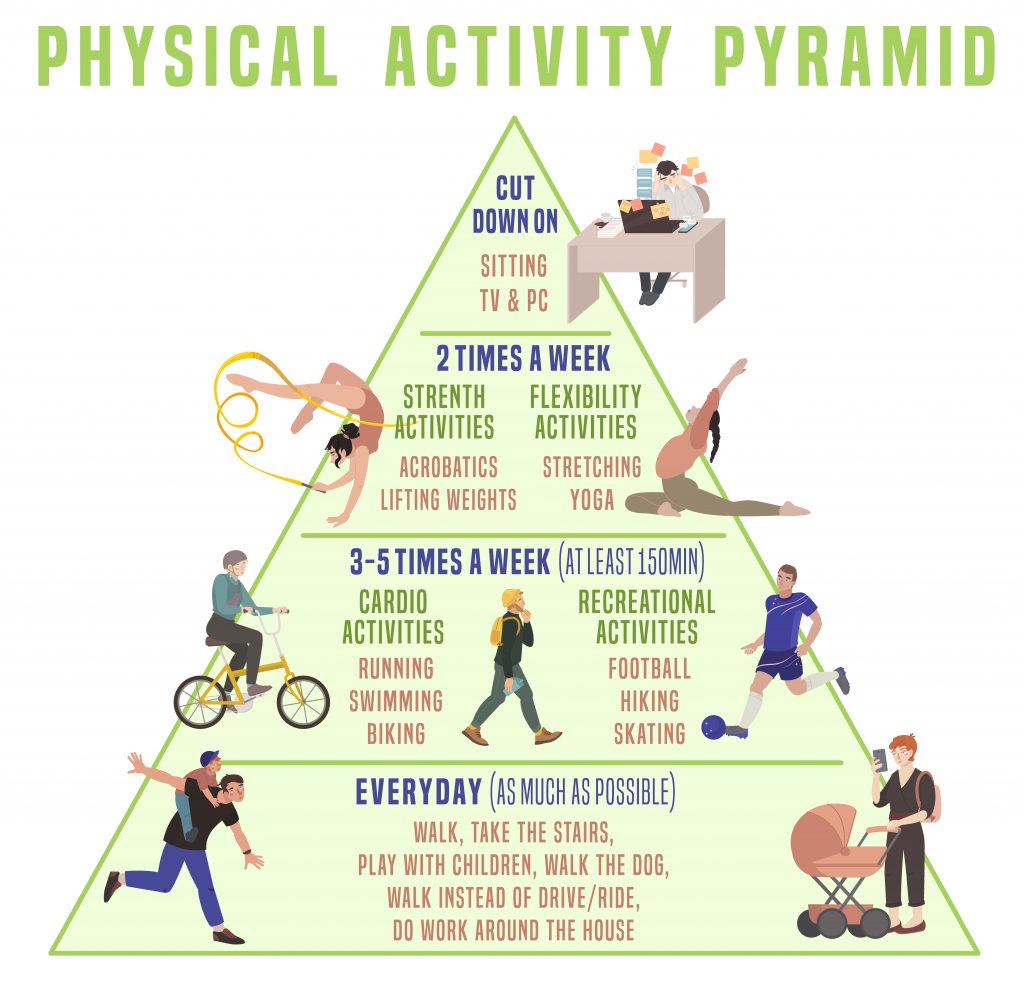
Have A Balanced Regime
Its best to begin gentle with 1-2 new activities and as you get fitter and more accomplished with these add more in to keep it interesting and keep your health and stamina improving.
- Start gentle – get your sensors switched on and your blood flowing
- Increase your flexibility gently
- Build some aerobic capacity
- Get your balance and coordination
- Build endurance
- Build strength
Generally build yourself up daily and medium term along this progression.
If you are really pushing yourself to the limit with your strength and stamina, you might be best not stretching within an hour of times you need to perform at a very high level, as stretching can slightly reduce muscle strength for a short while.
Timing And Frequency
The general guidance is at least 30 to 60 minutes of moderate to vigorous physical activity on most days of the week.
Aerobic exercises, such as brisk walking, jogging, cycling, or swimming, should be performed for extended periods of time (30 to 60 minutes, three to six times weekly), with periods of moderate intensity (60% to 75% of maximal capacity) that total 30 minutes on most days.
Resistance training, using eight to 10 different exercise sets with 10 to 15 repetitions each for a minimum of 2 days per week, is also recommended to promote muscle strength.
Staying On Track
Make it a habit. Fitting regular bursts of activity into your daily routine can help. Getting up to make a cup of tea, doing a few exercises whilst standing or sitting, walking or cycling to the shop all can help.
Track your progess. Celebrating your your achievements, however small can help you stay motivated.
Exercise with others. Find a workout buddy or join a group class. Exercising with others can provide encouragement and make physical activity more enjoyable.
Reward yourself. Set milestones and reward yourself when you reach them. This could be as simple as a relaxing bath after a week of consistent exercise or a new workout outfit after a month.
Make Sure You’re Well Nourished
- L-Glutamine – good for helping prevent muscle pain when you start a new regime
- If your building muscle – get yourself a protein hit within an hour after exercise
- Don’t over eat before exercise
- Stay hydrated. When sedentary we need to drink about 1.2 litres a day. This can increase up to 3.5 litres for exercising 60-90 minutes, depending on your fluid loss, which can be linked to temperature and exertion etc.
Recovery
- Exercise to a greater or lesser extent damages your body.
- It’s in the rest periods between bouts of exercise that your body responds to the strain by repairing. Give yourself time to recover.
- If your exercising to burn calories and lose weight – too much rest in response to exercise will counteract the calorie loss benefits of exercise.
- When you exercise your body diverts your blood to your muscles and heart and away from systems that help repair and maintain your body.
- If you become too ‘fight or flight’ dominant and not switching back into ‘rest and digest’ you won’t get the best response to exercise.
- A simple way to help your body switch modes are ‘anti-arousal breathing exercise’. To do this breathe out for twice as long as you breath in for 3-6 breaths to start with, especially before meals, when relaxing, after work and before bed.
- Sleep well and enough.
- If you are really ramping up your exercise, it’s good to deload every 6 weeks.
This is just a few of the things that might help. There’s a lot more depth and detail that might help you individually.
For more tips on preparing to exercise safely or to help get you in a good balance to help you enjoy your activites with reduced risk of injury, call Back-in-Action on 01772 749389 or email reception@back-in-action.com.
From the Preston Chiropractor Team
Getting You Back in Action & Enjoying Your Life Again
Serving the people of Preston and surrounding areas including Southport and Lytham St Annes